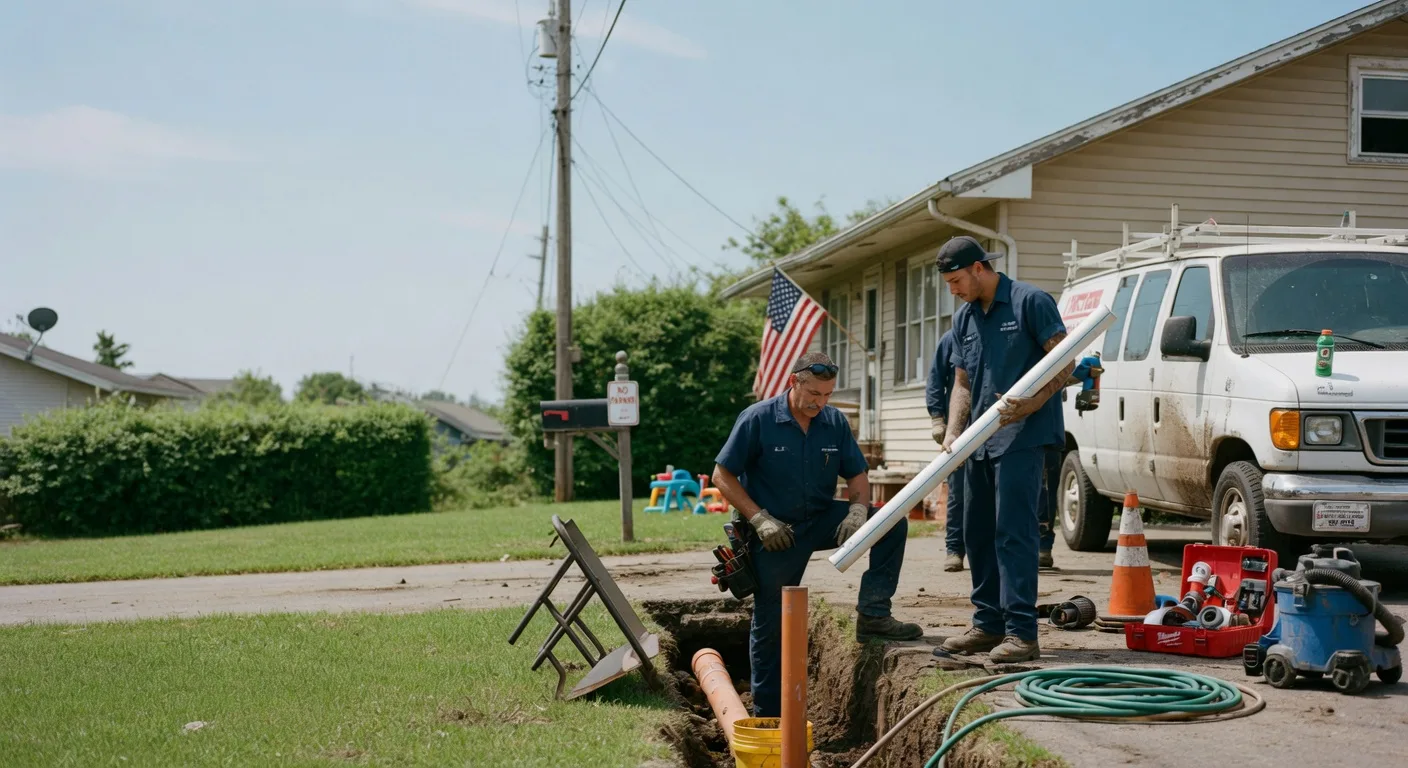
How do I know if tree roots have gotten into my sewer line?
Tree roots get into a sewer line through a hairline crack or a loose joint. Clay pipe is the usual victim because it is laid in short sections, so there is a joint every few feet for a root tip to find. Roots follow moisture, so a strand enters, thickens, and starts catching paper and grease until flow stops. Warning signs are a main line that clogs on a predictable schedule, gurgling from drains near large trees, and a cable machine that keeps stopping at the same distance. One slow fixture is rarely roots. Several drains slowing together, or a basement floor drain that rises, points to the main line where roots live. A cable with a cutting head opens a channel through the mass for temporary relief, and hydro jetting scours the pipe wall more completely, but neither seals the entry point, so the roots return. A camera inspection shows the crack or joint, how much root is present, and the pipe's condition, which decides whether periodic cutting is enough or a section needs repair. Access and the length of pipe involved drive that cost. PVC resists root entry far better than clay. For a suspected root problem in Chapel Hill, NC, Expert Plumbers Co connects you with an independent local plumber.
Prevention around trees is worth knowing about, because the root itself is rarely the whole story. Not every tree is a threat, and removing one is rarely the right first step, since the roots already in the pipe do not stop growing and the pipe's joints stay open. Willows, maples, poplars, and similar fast growers tend to be the worst for seeking out sewer lines, but any large tree in a dry spell can send roots to a pipe that holds moisture. Avoid pouring rock salt or copper sulfate products into toilets without asking a plumber first, since they can harm pipe and the wider water system. Keep records of when the line was last cut or jetted. If the intervals between clogs are getting shorter, that is a sign the root mass is thickening and a repair may soon be better value than repeated cleaning. Ask the plumber about replacement options.
Why did the clog come back worse after I used a store-bought drain snake?
You ran a snake from the hardware store, the water moved for a day, and now the sink is worse than before. That is common, and it comes down to the tool.
A thin hand-crank snake often punches a small hole through the middle of a clog. Water trickles through, so it seems fixed. The clog is still there, and it gets packed tighter as new debris catches on it. Sometimes the snake pushes the clog deeper into a bend, where it is harder to reach. A snake also does not scrape the pipe wall, so the grease build-up stays and the clog forms again quickly.
It is the wrong tool for roots, a bellied line holding water, or scale in cast iron. Those need a heavier cable with a cutting head, hydro jetting, or a camera inspection to see what is actually in the pipe.
Safe homeowner check: place a bucket under the trap, remove it and clear it by hand. Do not add chemical cleaners after snaking, because the plumber may then be working in caustic water.
Stop running water and call if the snake stuck or will not come back out, if other drains gurgle or back up, or if you smell sewage. That points past a single fixture to the main line.
Cost depends on access, what is found, and how much has to be opened up. Expert Plumbers Co is a referral service. Call (380) 262-9173 for Drain Cleaning help from a plumber serving Chapel Hill, NC.
After a failed snake attempt, leave the fixture alone and tell the plumber exactly what you did: the type of snake, how far it went in, whether it hung up, and whether you used any chemical cleaner first. That saves time on site and tells them whether the cable is still stuck or the clog was pushed into a bend. Do not keep running the snake in the hope that it will break through. Forcing a thin cable through a trap or a sharp bend can scratch the pipe wall or damage the trap, and in old cast iron it can knock loose scale that adds to the blockage. Also stop using the sink for a few hours if you can, because the extra water tends to carry loose debris deeper. Expect the proper clearing to include a look at the pipe wall afterwards, so you know whether this was a one-off blockage or a pipe that keeps catching debris.
Can my downspouts or sump pump cause a sewage backup?
Every drain is gurgling and dirty water comes up the basement floor drain, but only when it rains. That is not one slow sink. Storm water is a prime suspect.
In older housing stock, gutters, a yard drain or a sump pump discharge were sometimes plumbed straight into the sanitary sewer. In a storm, all that extra water floods the house lateral and the municipal main. The pipe runs full, so sewage is pushed back up the lowest opening: a floor drain, a basement shower, a laundry standpipe.
Many jurisdictions now prohibit this. Disconnecting it is often a permit or code matter.
Safe homeowner check: walk the outside of the house. See where each downspout ends. Does it spill onto the ground, or vanish into a pipe in the soil? Does the sump pump discharge run out to daylight, away from the foundation, or into a pipe tied to the house drain? Look only. Do not dig.
Stop running water and call now if more than one fixture is backing up, if sewage is rising, or if it is reaching the floor. A single slow sink is a different job, and a cable machine usually handles it. A storm-driven backup is not a clog, so cabling will not cure it.
A plumber finds the connection with a camera inspection, which shows a tie-in on the pipe, or a dye test, where colored water poured into a downspout or sump shows up in the sewer. What the work involves depends on access, the materials, how much has to be opened up, and any permit requirement.
Expert Plumbers Co is a referral service. We refer homeowners in Chapel Hill, NC to an independent local plumber for Drain Cleaning and Emergency Drain Cleaning. Call (380) 262-9173.
Once the connection is found, the usual fix redirects the storm water instead of changing the sewer. Downspouts can be extended to discharge onto the ground well away from the foundation, with the soil graded to carry water off. A sump discharge should run outdoors to daylight or to a drainage point that local code accepts.
A common mistake is capping the old pipe at the wall and leaving the buried tie-in open to the sewer. An open stub can still admit soil, roots and water. Ask the plumber to confirm the old connection is sealed at the sewer end, not just hidden from view.
Sump pumps run hardest during the very storms that load the sewer, so a pump that cycles constantly is worth mentioning on the call. After the change, watch the next heavy rain. The floor drain should stay quiet. If it still gurgles, the cause may be the street main or a damaged lateral, not the tie-in.
The laundry sink in my basement fills up when someone uses the drains upstairs. Why?
A basement laundry sink is often one of the lowest open drains in the house. When it fills with water from upstairs, that water is coming back up the main drain because the line below is blocked or too slow to carry it away.
Everything upstairs drains down through a vertical stack and into the main line that leaves the house. If that main line is partly blocked by roots at a clay joint, a bellied section holding water, or grease and wipes that have built up, the flow stops short and rises to the lowest point. That is the basement.
Check whether the floor drain, a basement toilet or a shower shows the same thing. If the laundry sink fills when you flush an upstairs toilet or run the washing machine, the main drain is the likely cause. If it only happens with the dishwasher or one bathroom, the blockage may be on a branch line instead.
Safe checks you can do: stop running water in the house for an hour and see whether the level drops. Find the cleanout, a capped pipe near the floor or outside wall, and note where it is for the plumber, but do not open it while the line is full. Do not run the washing machine or take showers to test it, and do not use chemical cleaner.
Stop all water use and call now if the water in the sink is dirty or smells, if it is rising, or if it spills over the rim. Sewage in a basement is a health hazard, so keep people and pets away and do not touch it without gloves.
A cable machine can clear a soft blockage in the main line from the cleanout. If it returns, or if the cable stops at the same spot, a camera inspection shows whether roots, a bellied pipe or a failed sewer lateral is behind it. Hydro jetting clears grease and roots more thoroughly than a cable, and a damaged line may need a repair or replacement section.
Cost depends on access to the cleanout, how far the blockage sits, whether roots or a collapsed pipe are involved, and how much has to be dug or opened.
Expert Plumbers Co can connect you with an independent local plumber in Chapel Hill, NC when you call (380) 262-9173.
Our main line backed up the day after a big family gathering. Did all those guests cause it?
Probably in part, but usually not on their own. A house full of guests puts far more water and waste through the drains in a day than the plumbing sees in a normal week: extra toilet flushes, showers, dishes, laundry, and a lot of toilet paper and food scraps. A healthy sewer line takes that in stride. A line that was already narrowed will not.
That is the common story. Roots at a clay joint, grease coating the pipe wall, a low spot that holds water, or scale in old cast iron can leave the line working at half capacity. Daily use hides it. Then a crowd of people finishes the job and the water has nowhere to go.
Some party habits do add to the problem. Grease and fat from cooking poured into the sink, food pushed into the disposal, paper towels and napkins in the toilet, wet wipes and feminine products all build up quickly. Guests do not know what the house can take.
Look at how the backup shows. If one toilet or sink is blocked, the trouble may be local to that fixture. If several drains are slow, a toilet gurgles when something else runs, or a basement drain or tub fills, the main line is the likely cause.
Safe checks you can do:
Stop using water, including the washer and dishwasher. Do not keep flushing to see if it clears. Keep people off wet floors.
Stop running water and call now if sewage is coming up inside, especially in the basement or a tub.
A cable machine often clears a mass of paper and grease. If the line backed up under a normal load before, or comes back after clearing, a camera inspection shows whether roots, a belly or a damaged section are the real reason. Cost depends on where the blockage sits, access to the cleanout, the tools needed and whether any repair follows, including permits under local code. To be connected with an independent local plumber in Chapel Hill, NC, call Expert Plumbers Co on (380) 262-9173.